

FOR ADULTS WITH ESSENTIAL TREMOR
The science behind steadier hands
Essential tremor can make the smallest movements feel uncertain, like holding a cup, signing your name, sharing a meal, or reaching for your phone.
Encora X1 was developed to work within the body’s natural movement pathways to help relieve hand tremors in the treated limb during stimulation.
Here’s the science behind how it works.
UNDERSTANDING ESSENTIAL TREMOR
The signal starts in the brain
The tremor shows up in the hand

Essential tremor is a neurological condition that affects movement. It’s associated with rhythmic signaling in the brain’s movement networks that becomes harder for the body to smooth out. Those signals travel through the nervous system to the muscles of the arm and hand, where they can appear as shaking during everyday activities.
What this means: Essential tremor is not a hand problem or a willpower problem. It is a neurological condition that affects movement control.

HOW ENCORA X1 WORKS
Working within the body’s natural movement pathways
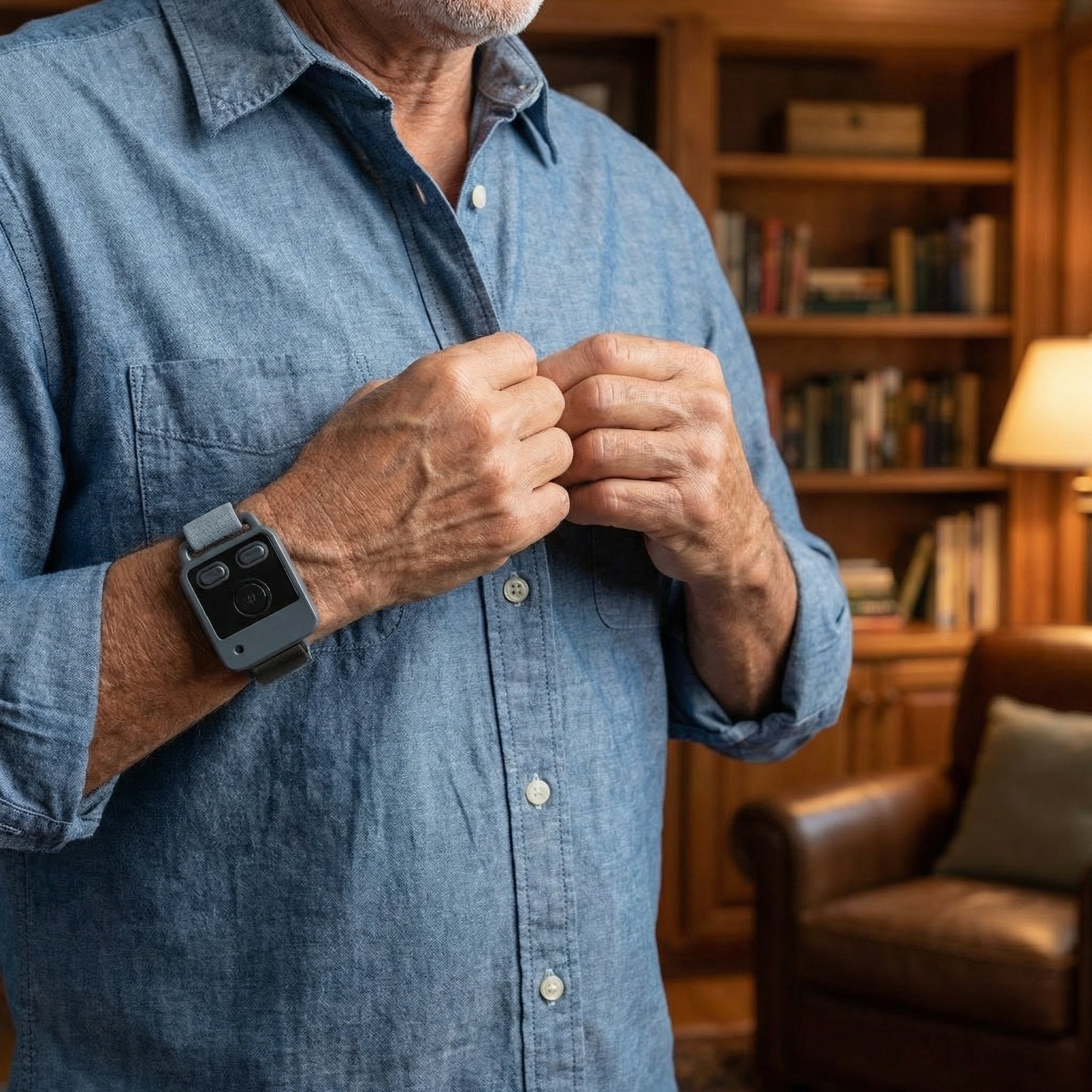
Encora X1 delivers gentle mechanical neurostimulation to stretch receptors in the wrist that are part of the movement feedback pathway between the brain and hand.
This mechanical input adds a new signal into the body’s natural movement feedback system. That added input helps disrupt the rhythmic signaling associated with tremor, helping the hand become steadier while stimulation is active.
What this means: The result many users notice is simple, steadier hands during use.
Experts Perspectives On Encora X1
“For the 7 million Americans suffering from essential tremor, medications are often ineffective or poorly tolerated, leaving invasive brain therapy as the only alternative. Non-invasive technologies like this represent an important area of innovation in the treatment of essential tremor.”
Ann Murray, M.D.
Principal Investigator and Chief of the WVU Rockefeller Neuroscience Institute (RNI) Comprehensive Movement Disorder Center
Clinical Evidence
Studied In The Clinic
Tested In Real Life
Encora X1 is FDA-cleared to aid in the relief of hand tremors in the treated limb during stimulation in adults with essential tremor. Our two initial clinical studies looked at both short-term response during stimulation and continued use at home over time.
Device effects observed in ~15 minutes
- 70–75%
Achieved meaningful tremor improvement in ULTRE clinical trial, compared to 48% of the sham group
- 78%
Observed benefit after 90 days (combined/pooled responder rate across both cohorts)
- 96%
Rated Encora X1 therapy as “comfortable all of the time”
Encora X1 is not a cure for essential tremor. In clinical trials, all device-related adverse events were non-serious, temporary, and self-resolving. Reported side effects include numbness (3%), buzzing/tingling sensation (3%), discomfort/pain (1.5%), skin irritation/rash (<1%), muscle weakness (<1%), and possible temporary worsening of tremor (<1%).
What Researchers Observed
ULTRE STUDY: How Active Modes Compared To An Inactive Sham
What Researchers Observed: In the ULTRE Study, participants using active therapy demonstrated greater improvement in daily-task performance and clinician-rated outcomes than participants using sham therapy.
More participants improved with active mechanical neurostimulation than with inactive sham stimulation.
What this means: The study measured changes in activities that reflect real hand use, not just abstract lab performance.
Randomized, double-blind, sham-controlled crossover study. Results are descriptive (feasibility design; no pre-specified effectiveness endpoint). Measured during stimulation.
Data on file.
Improved ability to do daily tasks
BF-ADL, ≥1-point, after 3–5 days of use
Rated improved by a blinded clinician
Clinical Global Impression of Change (CGI-C)
90-Day Home Use: Daily-Task Improvement At Day 90
90-Day Home Use Study: Improvements observed early in treatment were maintained through Day 90 for many participants.
In the home-use study, most participants showed improvement in daily-task ability at Day 90.
Prospective, single-arm, open-label study (no sham arm); raters blinded. Pooled across both cohorts (n=59), share improving on the BF-ADL daily-activities scale at Day 90 vs. Day-0 baseline measured during stimulation.
Data on file.
Daily-task improvement at Day 90
90-Day Home Use Study, pooled N=59
What Improvement Means
Measured In Everyday Activities
Researchers evaluated improvement using the Bain & Findley Activities of Daily Living Scale (BF-ADL). The scale looks at activities people perform every day, including:

Drinking from a cup

Using utensils

Writing or signing a name

Completing routine daily tasks
Common Questions
Science FAQs
Does Encora X1 use electrical stimulation?
No. Encora X1 uses mechanical neurostimulation and does not deliver electrical current through the body during therapy.
How is Encora X1 different from electrical tremor wearables?
Encora X1 uses mechanical neurostimulation instead of electrical stimulation. It’s designed to be worn throughout the day so support is there when you need it.
Encora X1 has no electrical contraindications, which means it can be considered for use in people with pacemakers, ICDs, insulin pumps, and other implanted electrical devices.
Compatibility with implanted electronic devices is supported by bench testing conducted in accordance with IEC 60601-1-2. Three participants with implanted electronic devices were included in the 90-Day Home Use Study. This limited clinical experience may not be representative of all patients or implanted devices. Talk to your doctor before using Encora X1.
How quickly does it work?
In clinical studies, some participants experienced device effects within approximately 15 minutes.
Is Encora a cure?
No. Encora X1 aids in the relief of hand tremors in the treated limb during stimulation.
Can I use Encora X1 with medication?
Yes. It can be used alongside medication or on its own when medication is no longer your preferred path.
What does FDA-cleared mean?
“FDA-cleared” and “FDA-approved” are two different routes a product takes to reach the market. Which one applies depends on the type of device and its risk category, not on how trustworthy or well-studied the product is.
Most wearable medical devices, including Encora X1, go through a process called 510(k) clearance. To be cleared, a device has to show the FDA that it is substantially equivalent to a device already legally on the market, and it is then subject to the FDA’s ongoing requirements for that device type. Encora X1 is FDA-cleared to aid in the relief of hand tremors during stimulation in adults with essential tremor.
“FDA-approved” is the term used mainly for prescription drugs and a smaller group of higher-risk devices, which follow a separate, longer approval pathway.

BUILT ON SCIENCE, DESIGNED FOR LIFE
See if Encora X1 is right for you
If you’re wondering whether Encora X1 could fit into your day, a Patient Advocate can help you understand next steps, coverage, and what to discuss with your doctor.
WEB-016 REV0